Lapis lazuli is one of the oldest gemstones in human history. Its deep blue, often scattered with gold-coloured flecks, was prized by the pharaohs, ground into pigment by Renaissance painters, and is still one of the most distinctive stones in men's jewellery. This guide explains what lapis lazuli is, what it means, how to judge its quality, how to spot imitations, and how to wear it.
What is lapis lazuli?
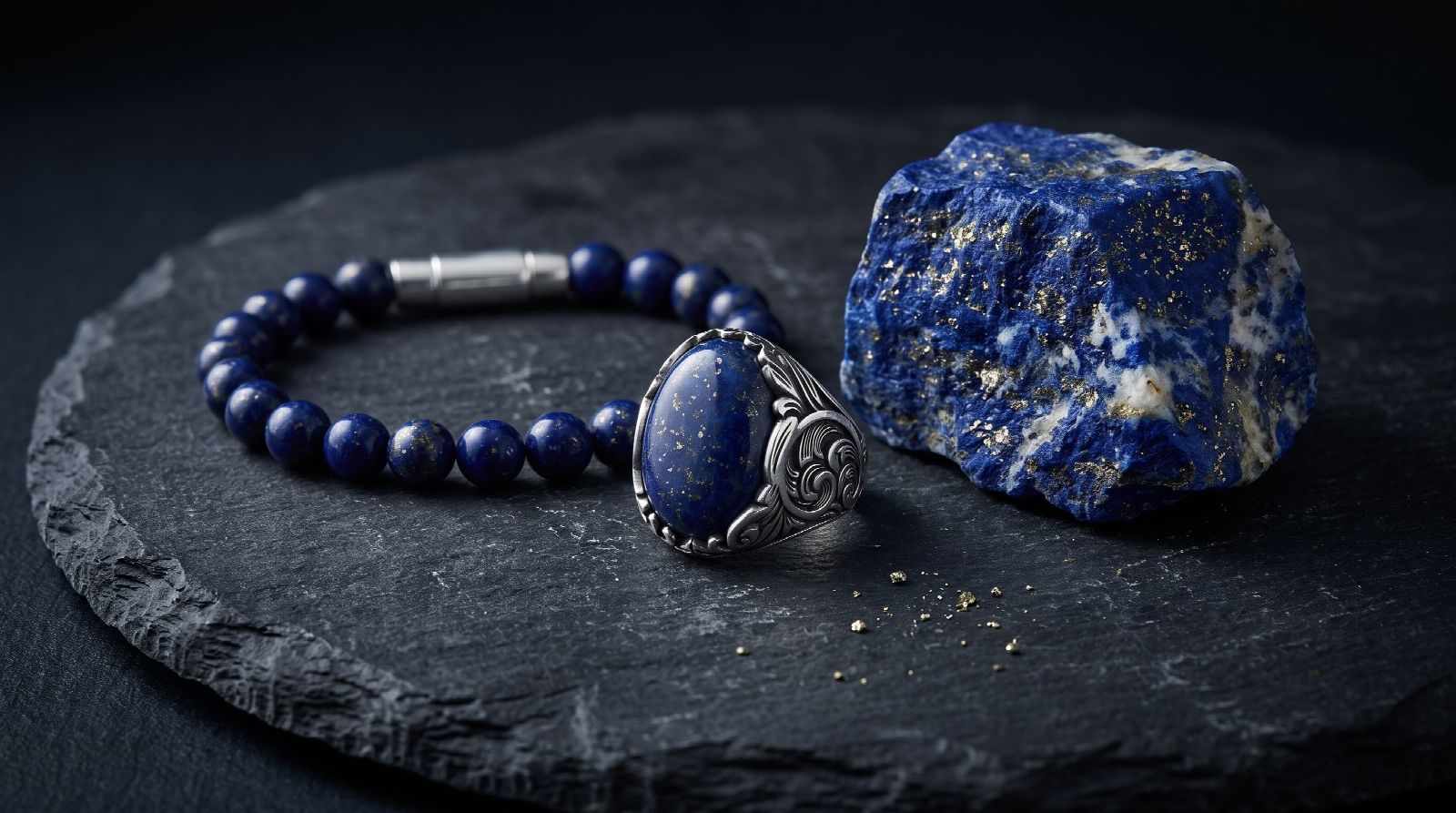
Unlike most gemstones, lapis lazuli is a rock rather than a single mineral. Its blue comes from lazurite; white streaks and patches are calcite; and the sparkling gold-coloured flecks are pyrite. The balance of the three decides how a stone looks and how it is valued.
It is fairly soft, around 5 to 5.5 on the Mohs scale, which makes it ideal for carving and inlay but means it needs a little care in daily wear.
The finest lapis comes from the Badakhshan region of Afghanistan, where it has been mined for more than 6,000 years. Chile produces a lighter stone with more white calcite, and there are smaller deposits in Russia and elsewhere.
Where the name comes from
"Lapis" is Latin for stone, and "lazuli" comes, through medieval Latin and Arabic, from the Persian lāzhward, the name of the place and the colour. The same root gave English the word "azure", which says a great deal about how closely the stone and its blue have been linked.
Lapis lazuli meaning
Lapis has been a stone of power and status for thousands of years. It was set into the funerary mask of Tutankhamun, carved into seals in Mesopotamia, and ground into ultramarine, the costly blue pigment used by painters such as Vermeer. Over that long history it has come to be associated with:
- Wisdom and truth: the stone most often linked with clear thinking and honesty.
- Royalty and authority: its colour was once reserved for rulers and sacred objects.
- Calm and inner confidence: the deep blue is associated with composure.
- Friendship: like turquoise, lapis has a long tradition as a meaningful gift.
These meanings come from history and tradition rather than scientific evidence; many men simply choose lapis for its rich colour.
How to judge lapis lazuli quality
- Colour: an intense, even royal blue is the most valued. Paler or greyish blue is less prized.
- Pyrite: a light scattering of gold flecks adds character and is a sign of genuine lapis; heavy pyrite lowers the value.
- Calcite: small white spots are normal, but large white areas reduce both beauty and value.
- Polish: good lapis takes a smooth, glassy polish with no dull patches.
Is lapis lazuli expensive?
Lapis lazuli is affordable compared with gemstones such as sapphire, but quality makes a large difference. Deep, even Afghan stones with fine pyrite cost considerably more than pale or calcite-rich material, and large, clean pieces for carving are rarer still. In a silver ring, the setting and craftsmanship usually account for a larger share of the price than the stone.
Lapis lazuli in sterling silver


How to tell if lapis lazuli is real
- Look for pyrite and calcite: natural lapis usually shows at least some gold flecks and small white spots, scattered irregularly.
- Compare with sodalite: sodalite is the most common look-alike. It is usually a more violet or royal blue with white veining and rarely contains pyrite.
- Beware of dyed stones: "Swiss lapis" is dyed jasper, and howlite is also dyed to imitate lapis. Dyed stones often show colour pooling in cracks and a uniform, flat blue.
- Watch for synthetic lapis: man-made versions exist and can be convincing; a gemmological lab can confirm.
- Buy from a seller who names the stone clearly and can answer questions about it.
Caring for lapis lazuli
Because lapis is soft and slightly porous, remove it before washing, swimming or exercising, and keep it away from perfume, cleaning products and ultrasonic cleaners. Wipe it with a soft, slightly damp cloth, dry it straight away, and store it apart from harder stones and metal that could scratch it.
Wearing lapis lazuli
Deep blue and sterling silver make one of the strongest combinations in men's jewellery, and lapis also looks rich in gold. A lapis lazuli ring works well with navy, grey and white, and a lapis bead bracelet adds colour without much weight. For other stones and what they traditionally mean, see our guide to beaded bracelet meanings.
Lapis lazuli rings and bracelet


Frequently asked questions
What does lapis lazuli symbolise?
Traditionally wisdom, truth, royalty and calm confidence.
Where does the best lapis lazuli come from?
The Badakhshan region of Afghanistan has produced the finest lapis for thousands of years.
What are the gold flecks in lapis lazuli?
Pyrite, an iron mineral. A light scattering is a natural and attractive feature.
Can lapis lazuli get wet?
Briefly, yes, but it should not be soaked or cleaned with chemicals, because it is soft and porous.